BEYOND
PRIVATE
ORDERFLOW.
Private RPCs protect your tx. LIP protects the Pool State. We solve the $500M leakage problem by enforcing intent-based liquidity at the hook level.
The Leakage Visualized.
When you add $1M liquidity, bots see the pool state update instantly. LIP "muffles" this signal by breaking your $1M intent into stochastic, non-deterministic chunks.
LIP_PROTO_V4_V2
01. The Intent Buffer
LPs deposit assets into a non-custodial vault. They define 'How' and 'When' through verifiable intents, not immediate swaps.
02. Stochastic Activation
Liquidity enters the Uniswap pool in bounded, randomized chunks. This removes the block-level signaling that MEV bots thrive on.
03. The v4 Gatekeeper
A custom hook forces all liquidity through the Intent Protocol. Direct pool interactions are hard-reverted at the runtime level.
The Advantage
LIP vs Legacy LP Solutions
| Feature Set | LIP (Our Prot.) | TWAMM Hooks | Privacy RPCs |
|---|---|---|---|
| Enforcement Level | Pool-Level (Hook) | Strategy-Level | RPC-Level |
| Bot Protection | Structural (Chunking) | Predictable Path | Metadata only |
| MEV Resistance | Target: 90%+ | Partial (JIT Risk) | Low (Post-trade leak) |
| Capital Efficiency | High (Dynamic Bounds) | Fixed Intervals | Standard |
Legacy Problem: TWAMM
TWAMMs have fixed intervals (e.g. every 10 mins). Bots anticipate these schedules and sandwich the liquidity move perfectly. Prediction = Exploitation.
LIP Solution: Stochastic
LIP uses randomized, bounded intervals. Bots cannot predict when the next chunk will hit. Uncertainty = Security.
In The News
Featured coverage and press releases
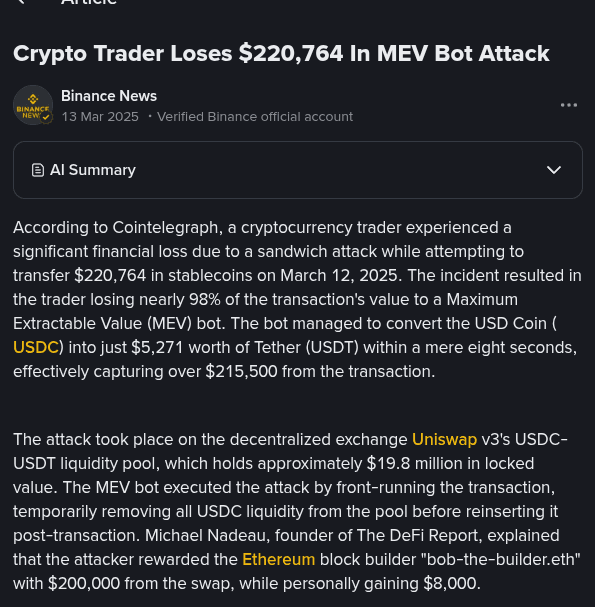
Industry Coverage
Read the full article about LIP Protocol's innovative approach to MEV protection.

Press Release
Learn more about our latest developments and milestones in DeFi security.
// REVERT ALL DIRECT ATTEMPTS
function beforeAddLiquidity(address sender, ...) external override {
    if (!isAuthorizedLIPExecutor(sender)) {
        revert UnauthorizedDirectLiquidityActivation();
    }
    // Logic proceeds only via LIP-controlled chunks
    processIntentChunk(params);
}